Enjoy Our Foods
Earlier this week, we explored pemmican, the prairie superfood that helped mould the development of our nation, here you will find information about the foods that fueled our families. I hope you get cooking and try some of our traditional foods.
https://www.cbc.ca/player/play/2682791751
Though bannock comes to us from the Scottish culture that serves as one of the roots of our Metis Nation, the dish has quickly become a staple for us. The calory dense food was easy to make and store, and is made from cheap ingedients. This made it perfect for our on the move ancestors that lived very physcially demanding lives. With high calorie foods being in short supply in the wild, bannock was an important food.
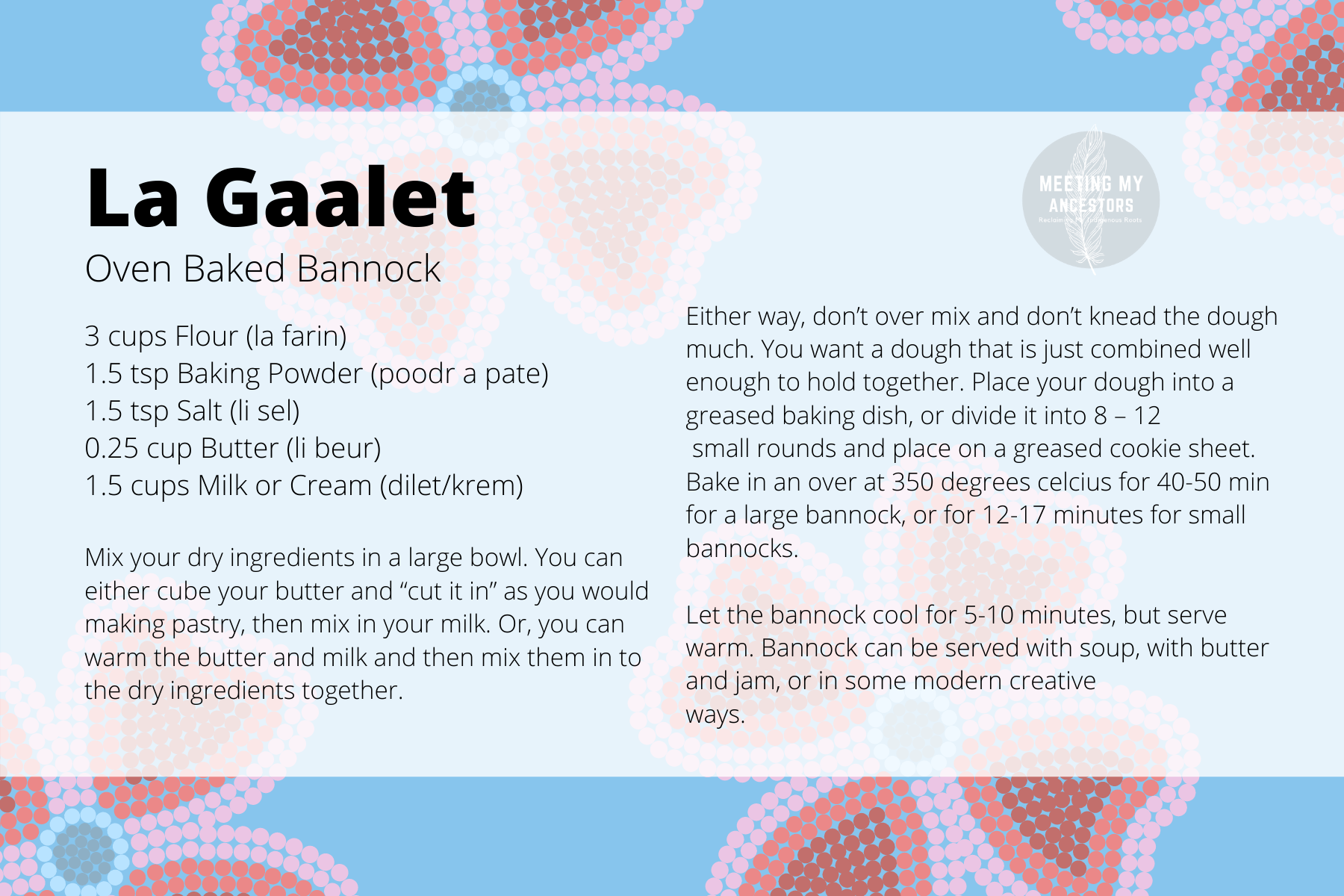
- 3 cups flour
- 1.5 tsp salt
- 1.5 tsp baking powder
- 1.5 cups milk (or water)
- 0.25 cups butter or lard
Mix your dry ingredients in a large bowl. You can either cube your butter and “cut it in” as you would making pastry, then mix in your milk. Or, you can warm the butter and milk and then mix them in to the dry ingredients together.
Either way, don’t over mix and don’t knead the dough much. You want a dough that is just combined well enough to hold together.
Place your dough into a greased baking dish, or divide it into 8 – 12 small rounds and place on a greased cookie sheet. Bake in an over at 350 degrees celcius for 40-50 min for a large bannock, or for 12-17 minutes for small bannocks.
Let the bannock cool for 5-10 minutes, but serve warm. Bannock can be served with soup, with butter and jam, or in some modern creative ways.
The following recipe book was created by the Metis Center, National Aboriginal Health Organization (2008) and is available for free. In it you will find recipes for rabbit, moose, fish and more. You can download it here.
The cookbook can also be found here if you have trouble with the link button; https://ruor.uottawa.ca/bitstream/10393/30573/1/Cookbook_SecondEdition.pdf
Wild Foods
Watch in future weeks for wild traditional ingredients that were used in our traditional foods and recipes that call for them.