The Metis Nation developed over generations through the natural relationships between families of free men, trappers, traders, and hunters who’s fathers and grandfathers were company men of the Northwest Company and sometimes the Hudson Bay Company. These voyageurs took wives from the nations they lived amongst. The children of these country marriages are the mothers and fathers of our nation.
Having a similar lifestyle and positions as guides, trappers, traders and hunters, these families took up residence near the forts and trading posts that formed the basis of their livelihoods. These sites became the birthplace of our nation.
With a shared identity, values, lifestyle, and languages, these families survived together as a collective. For this collective, the young Metis Nation, nothing was more important that the buffalo hunt.
History Rooted in Our Foods
One of the strongest driving forces that brought together these families to work together was the pemmican trade. Pemmican, a common food for voyageurs, explorers and traders, was commonly made from this continent’s roaming giants, the buffalo (which we call bison).
Following herds of bison, these early Metis families worked together to ensure safety and survival on the hunts. Following a strict code, the hunting parties would sometimes travel for weeks and months to find and follow the immense herds of bison that would ensure their survival.
This indigenous superfood was a whole family enterprise, with men hunting the bison, women and children cutting the meat and processing the hides, and matriarchs making the vital food source, pemmican.
Learn more about pemmican in this video series. Watch carefully…we will be challenging you to try your hand at this traditional food in the coming weeks.
Working together with their allied nations, the Cree and Saultaux, who together formed the Iron Alliance, these families would ensure success following the Laws of the Prairie.
These laws prevented greed, ensured safety, and were taken seriously.
Before we set out, you need to know the Laws of the Prairies (or Laws of the Hunt). Not adhering to these laws could mean loosing your saddles, your clothing, your horse, or worst of all, being shamed in front of our community and having your failure to keep our laws known.
So, let’s make sure that you understand our rules.
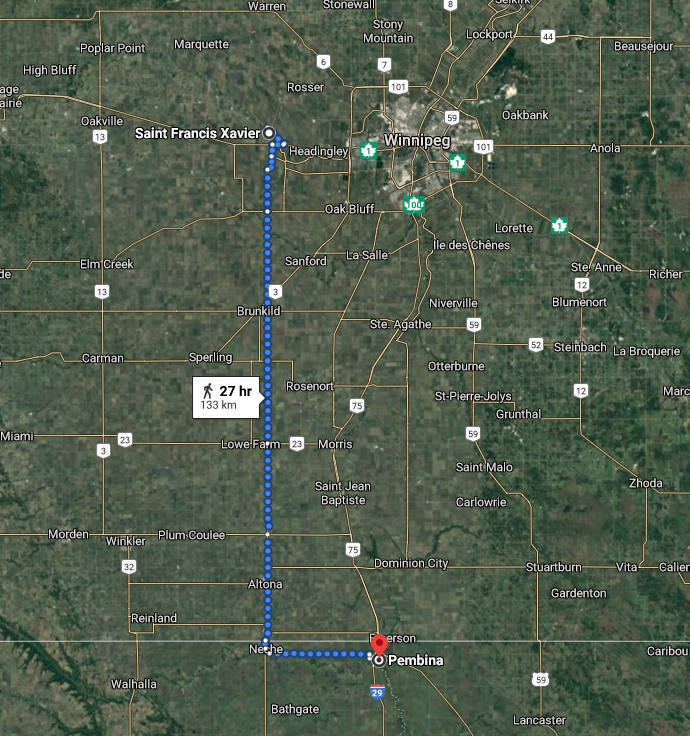
We are travelling to Pembina to rendez-vous with all of the Metis communities (St. Boniface, Pembina, and St. Francois Xavier) for our summer hunt. When we arrive, we will decide upon who will lead the hunt. All of our families will elect captains. These captains will form the council and leading them all would be the chief of the hunt.
“It was [Cuthbert] Grant who set up the organization that would grow into the legendary Metis hunts. Grant brought the wild and indipendent Freemen and Brules together. He fostered and atmosphere where they maintained their pride and freedom and yet still learned to work together as a unit. Grant divised the democratic rules-the command structure, the elections and the laws of the hunt. Rarely has such a charismatic leader been so effective on the administrative and organizational front. Rarely has such a leader been able to transform enthusiasm and exuberance into an institution built on everything the Metis cherishes – freedom, mobility, democaracy, the family and the hunt.” – Jean Teillet in The Northwest Is Our Mother